
The country's real GDP growth in the first quarter will be better than the Reserve Bank's estimate of 8 per cent, economists said on Tuesday. Economists at the country's largest lender SBI pegged the growth at 8.3 per cent while domestic rating agency Icra estimated it to come even higher at 8.5 per cent. The Reserve Bank of India (RBI), which expects the GDP to grow at 6.5 per cent in FY24, has estimated a growth of 8 per cent in the April-June period.

GDP growth for the current year is expected to be about 8.5 per cent while inflation likely to be below five per cent, Reserve Bank of India Governor Y V Reddy said in Chennai on Friday. "For the current year, though subject to review, current expectations is GDP growth will be 8.5 per cent.Inflation would be below five percent," he said at a management seminar conducted by the Great Lakes Institute of Management.

The Indian economy is likely to witness close to double-digit growth in the current fiscal year despite the second COVID-19 wave ravaging the country, Principal Economic Adviser (PEA) Sanjeev Sanyal said on Wednesday. The economy is slowly getting back to normalcy as the number of COVID-19 cases is declining, he said while participating in India Global Forum event. "We are probably going to see close to double-digit, if not double-digit (growth) in this financial year," he said.
Poor rainfall in rain-dependent central and southern India in the next three weeks could affect agricultural GDP growth in the coming season, a report by broking firm Motilal Oswal has said.

India's likely medium-term potential growth will almost certainly be markedly lower than that experienced in pre-pandemic years, warns Shankar Acharya, former chief economic advisor to the Government of India.
The overall gross domestic product growth for 2004-05 is expected to be 6-6.5 per cent, taking into account risks of high and uncertain oil prices and changes in international liquidity environment, says RBI's report on currency and finance 2003-04.

Uttar Pradesh Chief Minister Yogi Adityanath announced that the state has secured investment proposals worth approximately Rs 50 trillion over the past nine years, attributing this economic revival to the enforcement of the rule of law and strategic policy changes. He affirmed UP's trajectory towards becoming a $1 trillion economy by 2029-30.

India's first trillion-dollar company will be built on technology it owns, not just operates, predicts Ajay Kumar.
Asian Development Bank on Thursday pegged India's economic growth at 7.4 per cent for 2004 and said high growth is likely to be sustained in medium term.

NCAER said the monetary policy measures are unlikely to revive growth at this juncture and suggested providing fiscal stimulus, which too can be challenging unless it can be financed through better revenue generation.

It seems odd to criticise a country for delivering growth rates in standards of living and consumption that have been perhaps the fastest, longest, and most broad-based (affecting hundreds of millions of people) in history, points out Arvind Subramanian.
Foreign investment firm Credit Suisse First Boston said on Thursday that delayed monsoon is unlikely to have a "significant impact" on India's economic growth pegged at 5.7 per cent in 2004-05.
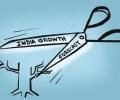
The International Monetary Fund (IMF), in its latest World Economic Outlook report, has slashed its forecast for India's FY23 gross domestic product growth to 8.2 per cent from 9 per cent, saying that higher commodity prices will weigh on private consumption and investment. This was one of the steepest cuts for emerging economies compared to the IMF's January WEO forecasts. Saying that global economic prospects have worsened significantly due to commodity price volatility and disruption of supply chains caused by the war in Europe, IMF cut its global growth outlook for calendar year 2022 to 3.6 per cent from 4.4 per cent, and said both Russia and Ukraine could experience large GDP contractions.
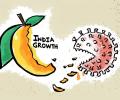
The Reserve Bank on Wednesday retained the GDP growth forecast at 9.5 per cent for the current fiscal but cautioned that the economic recovery is not yet strong enough to be self-sustaining and durable.

Here are the key numbers to watch out for in the Union Budget for 2025-26:
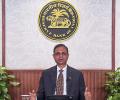
For the time being, the RBI is done with the cuts. A cut in October, which many are still predicting, is not certain. Of course, if growth nosedives, the script will be different, expects Tamal Bandyopadhyay.

'The real shock is going to be from a deficient monsoon.'
The government on Friday said the economy may have expanded by 4.5 per cent in 2012-13, compared with the earlier estimate of 5 per cent, on account of subdued performance in agriculture, mining and manufacturing.

Optimism comes at a time when several agencies trimmed forecast to as low as 5.5% citing inaction policy paralysis as major growth impediment

The Indian economy is expected to grow around 10 per cent during the current financial year on the likelihood of fewer COVID-19-linked supply disruptions and buoyancy in the global economy, said Poonam Gupta, director general of economic think-tank NCAER. The real challenge, however, would be to sustain a growth rate of 7-8 per cent in years to come, she said. "We could see annual growth in the ballpark range of about 10 per cent. "The reasons for this perceived optimism are: fewer supply disruptions; increased pent-up demand in the traditional and contact-intensive services; and a buoyant global economy.

Even if there is an early agreement on a cessation of hostilities in West Asia, the price shock will not go away easily, points out A K Bhattacharya.

'Once the currency goes out of the hand, then possibly your major challenge is that it will not come back.'

There are vexing questions around the disconnect between Nifty returns and portfolio returns, between economic growth and earnings growth, and finally, between earnings growth and market returns, points out Debashis Basu.
A ramp-up in COVID-19 vaccination, healthy advance estimates of kharif (summer) crop and faster government spending were the factors which led to the revision, the agency said in a statement. It can be noted that after the 7.3 per cent contraction in 2020-21, there were expectations of a higher growth number in 2021-22.

Beside manufacturing, deceleration was also witnessed in sectors like agriculture, construction and electricity, gas and water supply.

'Investors shouldn't let fear dictate their decisions. The most important step is simply to begin investing.'

Economists at the country's largest lender SBI on Wednesday said they see Q2 real GDP growth slowing down further to 6.5 per cent in the September quarter of this fiscal year. Amid concerns over the country's economic growth rate and if it is slowing down, the analysts said they expect FY25 growth to come "closer to" 7 per cent. It can be noted that the April-June period saw the real GDP expanding by 6.7 per cent, the lowest in 15 quarters.

This is the time for India to plan forward fully, with the goal of Atmanirbharata, and energy security. The Persian Gulf is no longer a reliable source, points out Rajeev Srinivasan.
World Bank has predicted a downward trend for India's GDP in 2008. China to follow too.

India's services sector growth rose to a two-month high of 58.5 in January, on faster expansion in new business intake and output, prompting service providers to hire additional staff, a monthly survey said on Wednesday.

Investors are sceptical that the economy could have picked up so much steam.

A look at six indicators shows all of them have collapsed from positive growth in April to contraction in September.

Karan Adani of Adani Ports & Special Economic Zone emerged as the top absolute value creator, adding Rs 2.67 trillion as the company's mcap rose from Rs 42,149 crore in March 2020 to Rs 3.09 trillion in March 2026 (7.3x) -- the largest rupee addition on the list.

'The West Asia or the Gulf crisis has shown that what we develop as national infrastructure when things are not as bad as they could be, we forget to plan for adversities.'

Real GDP growth surprised on the upside in 2025, but weaker nominal growth, trade uncertainty, and soft demand signal a bumpier road ahead.
We expect the region to record another year of solid growth in 2011, the survey said.

NSO has pegged economic growth at 5 per cent in 2019-20 in its second advance estimates.
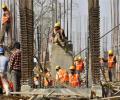
The First Advance Estimates of National Income, 2016-17 did not reflect the impact of demonetisation, effected on November 9 and are based on sectoral data for only seven months to October.
Global rating agency Moody's on Thursday placed India on a possible upgrade on foreign currency debt and painted a rosy picture for the economy, projecting a seven per cent growth.

RBI Governor Shaktikanta Das said that early containment of the pandemic could impart an "upside" to the economic growth outlook.
